 ISO 9001:2015 · Characteristic extraction
From drawing to audit-ready spec. Minutes, not hours.
CertX reads your technical drawings and balloons every inspection characteristic — dimensions, tolerances, threads, surface finish — into an audit-ready ISO inspection sheet.
- Your drawings are stored in the EU
- Every value traceable to the drawing
- Nothing is final until you approve it
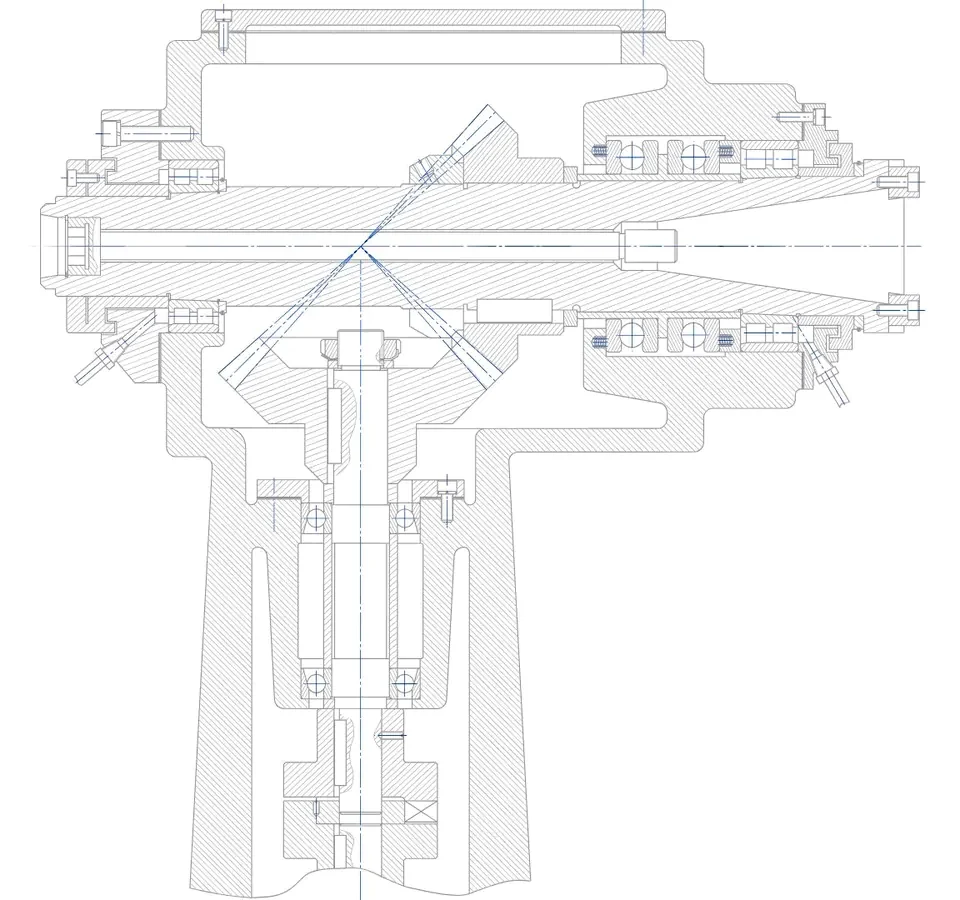
Ballooning by hand is slow — and one miss is a finding.
Transcribing a busy drawing means squinting at every callout, copying tolerances into a table, and hoping nothing slipped. CertX does the reading; you do the deciding.
Manual ballooning
One engineer, a highlighter, and a spreadsheet.
- 2–4 hours per multi-view drawing
- Tolerances and GD&T retyped by hand
- Missed characteristics surface during the audit
- No trace back to where a value came from
Automatic extraction
The engine reads, balloons, and tabulates. You review.
- A ballooned inspection sheet in minutes
- Dimensions, tolerances, threads & finish captured
- Low-confidence items flagged for a human
- Every value links back to the drawing region
The maths, measured — not promised.
Ten real production drawings, timed end to end. 156 inspection characteristics. Here is what they cost by hand, and with CertX.
| Drawing | Points | CertX (measured) | By hand (est.) | Faster by |
|---|---|---|---|---|
| Drawing A | 6 | 11.5 s | ~24 min | ~125× |
| Drawing B | 10 | 15.9 s | ~30 min | ~113× |
| Drawing C | 10 | 17.4 s | ~30 min | ~103× |
| Drawing D | 13 | 18.5 s | ~35 min | ~112× |
| Drawing E · rev 1 | 13 | 19.3 s | ~35 min | ~107× |
| Drawing E · rev 2 | 13 | 44.3 s | ~35 min | ~47× |
| Drawing F | 14 | 21.0 s | ~36 min | ~103× |
| Drawing G | 16 | 28.2 s | ~39 min | ~83× |
| Drawing H | 20 | 28.2 s | ~45 min | ~96× |
| Drawing I | 41 | 61.1 s | 1 h 17 m | ~75× |
| Total · 10 drawings | 156 | 4 min 25 s | ~6 h 24 m | ~87× |
- Extraction times are measured on 10 real production drawings (6 to 41 characteristics each), timed end to end — total 265.4 s, average 26.5 s.
- The manual figure is an estimate: 15 min setup per drawing plus 1.5 min per characteristic. The honest range is roughly 4–10 hours for these ten; ~6.4 h is the midpoint.
- Labour rate: €4,500 gross/month ≈ €27/h over ~167 productive hours. Fully loaded with ~21% employer contributions it is ~€33/h.
- End-to-end and cost figures include human verification. A person still checks the drafted sheet — but verifies a finished document rather than building it from scratch.
- Accuracy is not yet formally measured. These savings hold only while extraction is good enough that checking beats redoing — which the evaluation set on real drawings is there to establish before any of this is quoted to a customer.
- CertX produces audit-ready inspection documents aligned to ISO 9001:2015 §8.4. It does not issue certificates.
How CertX gets you to an approved inspection sheet
- 01
Upload the drawing
Drop in a PDF or DXF drawing, a STEP, IGES or STL model, or a scan. Multi-view, sectioned, detail callouts — CertX handles real shop drawings.
PDF · DXF · STEP · IGES · STL · scan - 02
It reads & balloons
The engine detects each inspection characteristic, numbers it, and reads the nominal, tolerance and symbol.
vision + symbol parsing - 03
Review & export
Approve the high-confidence items, check the flagged ones, and export your ISO 9001 inspection sheet.
PDF · Excel · protocol
Upload the drawing — or the 3D model.
We accept all common formats: STEP, STP, IGES, STL and DXF. A technical drawing as a PDF works just as well.
Drawings
Read callout by callout, the way a person reads them.
- PDFVector or scanned, any number of sheets
- DXF2D CAD drawing, every text read exactly
- Scan · photoJPG, PNG, WEBP — read with OCR
3D models
Read from the model data itself — nothing guessed.
- STEP · STPEmbedded dimensions, fits and GD&T (AP242 PMI)
- IGES · IGSDimensions and notes stored in the file
- STLOverall size of the part from the mesh
Every model also gets its overall size and a shaded view. If a model carries no tolerances, add them in the workspace — or upload the drawing too. Working in DWG? Export the drawing as DXF or PDF — every CAD system can.
Every kind of callout, captured
If it’s an inspection characteristic on the sheet, CertX is built to find it and tabulate it.
Dimensions
Linear, diametral, radial and angular sizes pulled with their nominal value.
Tolerances & GD&T
Plus/minus limits, fits (H7/g6) and geometric symbols with datums.
Threads
Metric and imperial thread specs, pitch and class of fit.
Surface finish
Roughness callouts and finish symbols, read per face.
Weld & feature symbols
Weld symbols, chamfers and edge notes flagged as characteristics.
Notes & title block
Material, part number, general tolerances and revision from the block.
Traceable for the audit, confidential from the start
EU data storage
Drawings and results are stored in Frankfurt (EU). AI reading uses the Claude API (Anthropic, USA) under a data processing agreement and EU Standard Contractual Clauses.
Customer data kept apart from the drawing
Before the AI reads, black out customer names, addresses, logos or the whole title block — CertX finds them on its own server, without AI. Claude sees only the drawing; CertX reads the title block itself.
Full traceability
Each value links back to its region on the drawing — so an auditor can see exactly where it came from.
ISO 9001 export
Output an inspection sheet aligned to ISO 9001:2015 — as PDF, Excel, or a German Prüfprotokoll.
Frequently asked
What does CertX do?
CertX reads your technical drawings and balloons every inspection characteristic — dimensions, tolerances, threads, surface finish — into an audit-ready ISO 9001 inspection sheet. You review the result and approve it.
Does CertX issue ISO 9001 certificates?
No. CertX produces audit-ready inspection documentation that supports your ISO 9001 quality system. It does not issue certificates.
Which files and characteristics can it read?
Drawings as PDF (vector or scanned) or DXF, scans and photos (JPG, PNG, WEBP), and 3D models as STEP/STP, IGES/IGS or STL. CertX captures dimensions, tolerances and GD&T, threads, surface finish, weld and feature symbols, and the notes and title block (material, part number, general tolerances, revision). From STEP models it reads embedded dimensions, fits and GD&T (AP242 PMI); every model also gets its overall size. Working in DWG? Export the drawing as DXF or PDF.
How fast is it?
Measured on 10 real production drawings: 26.5 s per drawing on average, about 87× faster than ballooning by hand.
How do I export the result?
As an inspection sheet aligned to ISO 9001:2015, as PDF or Excel. Every value links back to its region on the drawing, so an auditor can see where it came from.
Where is my data stored?
Drawings and results are stored in Frankfurt (EU). AI reading uses the Claude API (Anthropic, USA) under a data processing agreement and EU Standard Contractual Clauses.
Does CertX need an AI provider?
No. Besides Claude, CertX has a built-in reading engine that reads CAD PDFs and DXF files exactly from their text and uses text recognition for scans and images. You choose the engine for every read; administrators can lock it for the whole company.
Does the AI see my customers’ data?
Only what you let it see. Before Claude reads, black out customer names, addresses, logos or the whole title block — CertX finds them on its own server, without AI. Claude sees only the drawing; CertX reads the title block itself. Administrators can make this automatic for every Claude read.
How are accounts protected?
Two-factor authentication is required for every account and enforced on the server and in the database. Accounts are set up by your administrator.
Is anything final without a human check?
No. Low-confidence values are flagged for review, and nothing is final until you approve it.
Start with one drawing.
Tell us about a part you’d normally balloon by hand. We’ll get back to you and show you the inspection sheet CertX gives back.
A real person answers every request — usually within 48 hours.
info@siyaya-digital.com